Persian rugs in Oceanside require specialized care due to 75–85% coastal humidity, salt air exposure, and sand tracking that can damage delicate wool and silk fibers within 6–12 months without proper protection. Professional cleaning every 12–18 months combined with daily maintenance, humidity control (target 40–55%), and immediate spill response can extend your Persian rug’s life from 50–100 years to 100–200+ years while preserving its $5,000–$50,000+ investment value.
If you own a Persian rug in Oceanside, you’re dealing with challenges that rug owners in dry climates never face. Our coastal environment with its salt air, high humidity, and constant sand tracking can destroy a $20,000 Persian rug in just a few years if you don’t understand proper care. Below, we’ll break down exactly what Oceanside’s climate does to Persian rugs, the specific care routines that protect them, and why generic rug care advice from the internet doesn’t apply to our coastal environment.
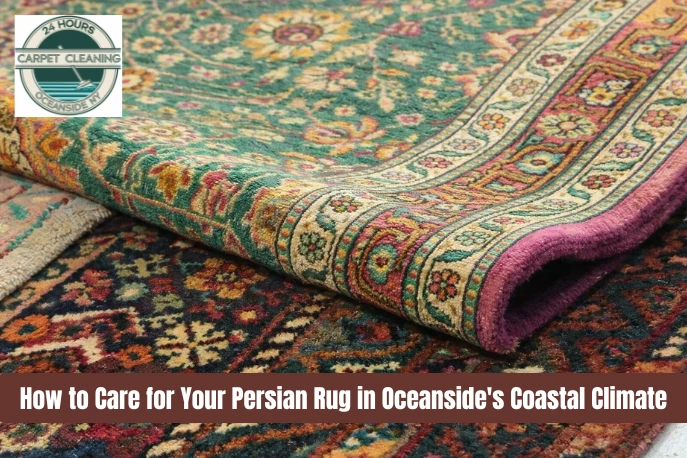
Why Oceanside’s Climate Is Particularly Hard on Persian Rugs
Persian rugs were traditionally made in Iran’s dry, arid climate the exact opposite of Oceanside’s humid coastal conditions. This creates fundamental compatibility problems.
Oceanside’s specific threats to Persian rugs:
- Salt air penetration: Coastal salt air enters homes and deposits microscopic salt crystals on rug fibers, attracting moisture and accelerating deterioration
- High humidity (75–85% year-round): Creates perfect conditions for mold, mildew, and moth larvae in wool fibers
- Sand and grit tracking: Beach sand is extremely abrasive, cutting through delicate wool and silk pile like sandpaper
- Temperature fluctuations: Rapid changes between outdoor and indoor temperatures create condensation that penetrates rug backing
- Ultraviolet exposure: Reflected sunlight from water and sand increases UV exposure that fades natural dyes
We’ve operated at 160 Lindbergh Ave in Oceanside for years, and we see the damage patterns consistently. Persian rugs in coastal homes show wear 2–3 times faster than identical rugs in inland homes. A rug that would last 100 years in Arizona might last only 30–40 years in Oceanside without proper care.
One client in Long Beach inherited a 1920s Persian Tabriz worth approximately $35,000. She kept it in her living room for five years with standard care (vacuuming, occasional spot cleaning). When we examined it, we found early mold development in the foundation, moth damage in low-traffic areas, and salt-accelerated fiber breakdown along the edges. Another 3–5 years and the damage would have been irreversible. Proper coastal care protocols saved her $35,000 investment.
Understanding Your Persian Rug’s Vulnerabilities
Not all Persian rugs are equally vulnerable to coastal conditions. Understanding your specific rug helps you provide appropriate care.
Persian rug construction types and coastal vulnerability:
| Rug Type | Primary Material | Humidity Vulnerability | Salt Air Vulnerability | Care Difficulty |
|---|---|---|---|---|
| Tabriz | Wool pile, cotton foundation | High | High | Moderate-High |
| Isfahan | Silk pile, silk foundation | Very High | Very High | Very High |
| Kashan | Wool pile, cotton foundation | High | High | Moderate |
| Heriz | Wool pile, cotton foundation | Moderate-High | Moderate-High | Moderate |
| Qom | Silk pile, silk foundation | Very High | Very High | Very High |
| Kerman | Wool pile, cotton foundation | High | High | Moderate-High |
| Nain | Wool/silk blend | Very High | Very High | High |
Material-specific vulnerabilities:
Wool Persian rugs: Wool is naturally hygroscopic (attracts moisture), which in Oceanside’s 75–85% humidity means your wool Persian rug is constantly damp at the molecular level. This creates ideal conditions for mold, mildew, and moth larvae. Wool also holds salt particles that attract even more moisture.
Silk Persian rugs: Silk is even more delicate than wool and incredibly susceptible to moisture damage, salt deterioration, and UV fading. A silk Persian rug in Oceanside without proper climate control can develop irreversible damage in 12–24 months.
Cotton foundations: Most Persian rugs have cotton foundations (the backing structure). Cotton in high humidity becomes a perfect breeding ground for mold and mildew, which attack the structural integrity of the entire rug from the inside out.
We offer specialized Persian rug cleaning that accounts for these material vulnerabilities and Oceanside’s specific climate challenges.
Daily and Weekly Maintenance for Coastal Conditions
Proper daily maintenance is 10 times more important in Oceanside than in dry climates.
Daily maintenance requirements:
1. Rotate your rug every 3–6 months Persian rugs develop uneven wear patterns from foot traffic and sunlight exposure. In Oceanside, where humidity varies throughout your home (higher near doors and windows), rotation every 3–6 months prevents moisture from concentrating in specific areas. Mark your calendar—this isn’t optional.
2. Control foot traffic Implement a shoes-off policy for any room with Persian rugs. A single grain of beach sand can cut through 50–100 wool fibers with repeated foot traffic. We’re not exaggerating beach sand has a Mohs hardness of 6–7, while wool fibers have a hardness of 2–3. It’s literally like walking on your rug with tiny knives.
3. Use rug pads (the right kind) Not all rug pads work in coastal humidity. Rubber-backed pads trap moisture and cause mold growth. Use only breathable felt pads or PVC/polyester mesh pads that allow air circulation. Replace pads every 2–3 years as they compress and lose effectiveness.
Weekly maintenance requirements:
1. Vacuum correctly (technique matters enormously) Use a vacuum WITHOUT a beater bar/rotating brush—these yank and tear delicate wool and silk fibers. Use suction-only attachment on low power. Vacuum in the direction of the pile (stroke the rug—the direction that feels smooth is the pile direction). Never vacuum fringe hand-clean it with a soft brush.
Frequency:
- High-traffic areas: 2–3 times weekly
- Moderate-traffic: Once weekly
- Low-traffic: Every 10–14 days
One mistake we see constantly: homeowners using their regular vacuum with beater bar on Persian rugs. After 2–3 years, the pile looks fuzzy and worn. That’s not age—that’s damage from aggressive vacuuming. A $15,000 rug can look like a $500 rug from improper vacuuming alone.
2. Check for early warning signs Every week, look for these problems:
- Musty smell (indicates mold development)
- Visible moths or moth larvae (tiny white worms)
- Shedding increase (wool breakdown from salt/humidity)
- Color changes or fading (UV damage or dye bleeding)
- Rippling or buckling (foundation moisture damage)
Catch these problems early and they’re fixable with professional intervention. Wait too long and damage becomes permanent.
Humidity Control: The Most Critical Factor
If you do nothing else from this article, control your indoor humidity. This single factor determines whether your Persian rug lasts 50 years or 200 years in Oceanside.
Target humidity range: 40–55%
Below 40% and wool fibers become brittle and crack. Above 55% and you create conditions for mold, mildew, and moth infestation. Oceanside’s outdoor humidity averages 75–85%, which means without intervention, your indoor humidity will match—far too high for Persian rug preservation.
How to control humidity:
1. Use dehumidifiers year-round Position dehumidifiers in rooms with Persian rugs, set to maintain 45–50% humidity. Empty daily (or use models with continuous drain). Budget $200–$400 for a quality dehumidifier that can handle 50–70 pints/day.
2. Improve air circulation Run ceiling fans year-round (even in winter) to prevent moisture pockets from forming. Air movement prevents the stagnant, humid conditions where mold thrives. Keep rugs at least 3 inches from walls to allow air circulation underneath.
3. Monitor with hygrometers Place digital hygrometers in rooms with Persian rugs ($10–$20 each). Check readings daily until you understand your home’s humidity patterns, then weekly for maintenance. When readings exceed 60%, take immediate action you’re in the danger zone.
4. Use air conditioning strategically AC removes moisture as it cools. In Oceanside’s moderate climate, running AC even when you don’t need cooling can control humidity. Set AC to “dry” mode if available.
We had a client in Rockville Centre with three Persian rugs (total value ~$60,000) who refused to use dehumidifiers because “it seemed wasteful.” After 18 months, all three rugs showed early mold development. We caught it during professional cleaning and recommended immediate humidity control. She finally installed dehumidifiers. Two years later, the rugs are stable with no further mold development. That $800 investment in dehumidification equipment saved $60,000 in rugs.
Sunlight and UV Protection
Oceanside’s coastal location means more UV exposure than you might expect.
Why UV damage is worse in Oceanside:
- Direct sunlight through windows
- Reflected light from nearby water
- Reflected light from sand and light-colored buildings
- Longer daylight hours in summer
Persian rugs use natural dyes (vegetable and mineral-based) that are beautiful but UV-sensitive. Six months of direct sunlight in an Oceanside home can fade colors that took artisans weeks to create.
UV protection strategies:
1. Window treatments Install UV-blocking window film (blocks 99% of UV while maintaining natural light) or use blackout curtains during peak sun hours (10am–4pm). Cost: $5–$15 per square foot for professional installation.
2. Strategic rug placement Never place Persian rugs in direct sunlight paths. If you must use a Persian rug in a sunny room, rotate it every 2–3 months so fading is uniform rather than creating visible light and dark sections.
3. UV-protective glass If you’re replacing windows, consider Low-E glass that blocks UV while maintaining visibility. This protects rugs, furniture, and artwork simultaneously.
One Isfahan silk rug we cleaned had been in a sunny Oceanside living room for just two years—half the rug was in direct sunlight, half was shaded by furniture. The color difference was shocking: the sunny side had faded 40–50% while the shaded side retained its original vibrancy. The rug’s value dropped from approximately $25,000 to maybe $8,000 because of uneven fading. Proper UV protection would have cost $500–$1,000. The owner lost $17,000 in value.
Spill Response in Humid Coastal Conditions
Spill response timing is even more critical in Oceanside’s humidity because liquids penetrate deeper and faster in moisture-rich environments.
Immediate response protocol (within 5 minutes):
For water-based spills (wine, coffee, juice):
- Blot immediately with clean white towels (colored towels can transfer dye)
- Never rub this spreads the stain and damages pile
- Blot from outside edges toward center to prevent spreading
- Continue blotting until no more liquid transfers to towel
- Place fan to speed drying (critical in humid environment)
- Call us at +1 516-905-5479 if stain remains after 24 hours
For oil-based spills (grease, makeup, body oils):
- Scrape up solids gently with dull knife
- Sprinkle cornstarch or baking soda to absorb oils (leave 2–4 hours)
- Vacuum gently with suction-only attachment
- Do NOT use water—it makes oil stains worse
- Call for professional stain removal within 24–48 hours
For pet accidents: Pet urine is the worst possible stain for Persian rugs because uric acid permanently breaks down wool and silk fibers. Our pet stain removal service uses enzymatic treatments that neutralize uric acid before it causes permanent damage but only if we get to it within 48–72 hours.
Critical timing for coastal humidity: In dry climates, you might have 30–60 minutes before a spill penetrates to foundation. In Oceanside’s humidity, that window shrinks to 10–20 minutes. The higher ambient moisture helps liquids wick deeper, faster. This is why immediate response is absolutely critical.
Professional Cleaning Schedule for Coastal Environments
Generic advice says Persian rugs need professional cleaning every 3–5 years. That’s wrong for Oceanside.
Recommended professional cleaning schedule for Oceanside Persian rugs:
| Rug Location | Traffic Level | Recommended Frequency | Why More Frequent in Oceanside |
|---|---|---|---|
| Entryway/hallway | High | Every 12 months | Sand and salt concentration |
| Living room | Moderate-High | Every 12–18 months | Body oils, food particles, humidity |
| Dining room | Moderate | Every 18–24 months | Food spills, under-table grit |
| Bedroom | Low-Moderate | Every 18–24 months | Body oils, humidity control critical |
| Low-traffic areas | Low | Every 24–36 months | Still needs mold/moth prevention |
These frequencies are 50–100% more frequent than inland recommendations because Oceanside’s salt air and humidity create contamination that home maintenance cannot address.
What professional cleaning removes from coastal Persian rugs:
- Salt crystals embedded in wool (home cleaning can’t reach these)
- Sand particles deep in foundation (cause structural damage if left)
- Mold and mildew spores (before visible growth occurs)
- Moth eggs and larvae (often invisible until infestation is severe)
- Oils and contaminants that attract more dirt and moisture
Our area rug cleaning facility uses specialized equipment designed specifically for Persian rugs. We never clean Persian rugs on-location in your home—they require controlled environment cleaning where we can:
- Test all dyes for colorfastness before full cleaning
- Remove 3–5 pounds of dry soil before wet cleaning (most people are shocked at how much comes out)
- Use pH-balanced solutions specific to wool and silk
- Control water temperature precisely (too hot damages natural dyes)
- Dry rugs in climate-controlled environment (prevents mold during drying)
- Inspect foundation for damage invisible from the pile side
For especially valuable pieces, our Oriental rug cleaning and antique rug cleaning services include hand-washing techniques that protect rugs over 50 years old where machine cleaning might cause damage.
Moth Prevention in Coastal Humidity
Moths are a bigger threat in Oceanside than most homeowners realize.
Why moths love Oceanside Persian rugs: Clothes moths (the species that eats wool) thrive in humidity above 60%. Oceanside’s 75–85% outdoor humidity creates perfect conditions. Female moths lay eggs in dark, undisturbed areas of rugs (under furniture, in closets, along edges). Larvae hatch and eat wool fibers for 2–6 months before pupating.
Signs of moth damage:
- Irregular bare patches in pile (larvae eat from foundation up)
- Visible moths flying near rugs (means infestation is already established)
- Small cocoons or casings along rug edges
- Increased shedding in localized areas
- Fine white powder (moth droppings) on or near rug
Moth prevention strategies:
1. Movement and light exposure Moths prefer dark, undisturbed areas. Move furniture on Persian rugs every 2–3 months. Expose entire rug to light quarterly. Vacuum under furniture monthly this disturbs eggs before they hatch.
2. Cedar products (limited effectiveness) Cedar blocks or chips emit oils that repel moths but lose effectiveness after 6–12 months. Sand cedar blocks quarterly to refresh oils. Don’t rely solely on cedar it’s supplementary, not primary protection.
3. Professional moth treatment If you see ANY signs of moths, call immediately for professional treatment. DIY moth killers often don’t penetrate deep enough to kill larvae in foundation. We use specialized treatments that eliminate eggs, larvae, and adult moths without damaging delicate rug fibers.
4. Storage protocols If storing a Persian rug, NEVER use plastic bags or containers (trap moisture and create mold). Wrap in acid-free paper, then in breathable cotton. Store in climate-controlled space with 40–50% humidity. Check every 3–6 months for moth activity.
One Kashan rug we cleaned had been stored in a plastic bag in the owner’s garage for three years. When she unwrapped it, 40% of the rug was destroyed by moths $18,000 in damage from improper storage. Proper storage would have cost $200–$300.
Dealing with Mold and Mildew
Mold is the silent killer of Persian rugs in Oceanside.
How mold develops: Mold spores are everywhere in Oceanside’s air (coastal proximity means high spore counts). When humidity exceeds 60% and wool or cotton stays slightly damp, spores germinate. Mold grows through the foundation, literally eating the cotton structure. By the time you see or smell mold, significant damage has occurred.
Early mold detection:
- Musty smell (strongest when you flip rug over)
- Discoloration on rug backing (black, green, or white spots)
- Rug feels damp even in dry weather
- Increased shedding or weak areas in pile
If you suspect mold:
- Stop using the rug immediately (walking spreads spores)
- Move to dry, well-ventilated area outdoors (sunlight kills surface mold)
- Call us immediately at +1 516-905-5479 for professional mold treatment
- DO NOT attempt DIY mold removal with household cleaners (they damage wool and dyes)
Professional mold remediation: We use specialized anti-fungal treatments that kill mold at the root level without harming rug fibers or dyes. The process includes:
- Complete inspection (often using UV light to see mold invisible to naked eye)
- Dry soil removal
- Anti-fungal pre-treatment
- Deep cleaning with controlled temperature and pH
- Complete drying in climate-controlled facility (24–48 hours)
- Post-treatment inspection to ensure all mold eliminated
Cost: $300–$800 depending on rug size and contamination severity. Expensive? Yes. But it’s cheaper than replacing a $10,000–$30,000 rug.
Special Considerations for Silk Persian Rugs
Silk Persian rugs require extra care in Oceanside’s coastal environment.
Why silk is especially vulnerable: Silk fibers are 100 times finer than wool, making them more susceptible to every type of damage. Humidity makes silk swell and lose strength. Salt literally dissolves silk protein over time. UV fades silk colors dramatically faster than wool.
Silk-specific care requirements:
1. Never place silk rugs in high-traffic areas Silk is for display, not durability. In Oceanside conditions, a silk Persian rug in an entryway will be destroyed in 2–3 years. Use silk rugs only in low-traffic, climate-controlled rooms.
2. Maintain stricter humidity control Silk requires 40–50% humidity (even narrower range than wool). Use dedicated dehumidifiers in rooms with silk rugs.
3. Professional cleaning annually Silk Persian rugs in Oceanside need professional cleaning every 12–18 months regardless of traffic level. Our silk rug cleaning service uses ultra-gentle cleaning methods with temperature controls and pH balancing specific to silk.
4. Never attempt DIY cleaning on silk Water temperature above 80°F can cause silk dyes to bleed. Improper pH can dissolve silk fibers. Wrong cleaning method can create permanent water marks. Professional cleaning is not optional for silk it’s required.
We’ve seen $40,000 silk Qom rugs destroyed by well-meaning homeowners who tried to “spot clean” a wine spill with tap water. The dyes bled, creating rainbow halos around the stain. The damage was irreversible. Professional emergency cleaning would have cost $300 and saved the rug.
Furniture and Rug Interaction
How you place furniture on Persian rugs matters in humid environments.
Furniture-related problems in coastal humidity:
- Furniture legs create pressure points that trap moisture
- Heavy furniture prevents air circulation under rug
- Metal furniture legs react with salt air and stain wool
- Furniture creates permanent crushing/matting in high humidity
Furniture placement best practices:
1. Use furniture coasters Place felt or plastic coasters under all furniture legs on Persian rugs. This distributes weight and prevents crushing. Replace coasters annually as they compress.
2. Rotate furniture position Move furniture 2–3 inches every 6 months to prevent permanent pile crushing. In Oceanside’s humidity, crushed pile is harder to restore than in dry climates.
3. Avoid metal-to-rug contact Metal furniture legs can rust from salt air exposure, then transfer rust stains to wool. Use coasters that completely separate metal from rug.
4. Leave breathing room Don’t cover more than 60–70% of a Persian rug with furniture. The uncovered areas allow moisture to escape and air to circulate.
Comparing Care for Different Oriental Rug Types
Persian rugs aren’t the only Oriental rugs that need special care in Oceanside.
Care comparison for coastal environments:
| Rug Type | Primary Material | Humidity Tolerance | Oceanside Care Difficulty |
|---|---|---|---|
| Persian | Wool/Silk | Low-Moderate | High |
| Turkish | Wool | Moderate | Moderate-High |
| Pakistani | Wool | Moderate | Moderate |
| Afghan | Wool | Moderate-High | Moderate |
| Chinese | Wool/Silk | Low-Moderate | High |
| Indian | Wool/Cotton | Moderate | Moderate |
If you have Turkish, Afghan, or other Oriental rugs, many of the same care principles apply. We offer comprehensive wool rug cleaning for all Oriental rug types, with protocols adjusted for each rug’s specific construction and materials.
Insurance and Documentation
High-value Persian rugs should be properly insured and documented especially in coastal environments with higher risk factors.
Documentation requirements:
- Professional appraisal (update every 5 years as value changes)
- Detailed photos of entire rug and any unique features
- Photos of rug backing/foundation (identification if stolen)
- Professional cleaning receipts (prove proper maintenance)
- Repair records if applicable
Insurance considerations: Standard homeowners insurance often caps coverage for rugs at $1,000–$2,500. For Persian rugs worth $5,000+, get a scheduled personal property rider that covers:
- Full replacement value
- Damage from mold, moths, floods (common coastal risks)
- Professional cleaning and restoration costs
- Theft coverage
Cost: typically 1–2% of rug value annually. For a $20,000 rug, that’s $200–$400/year. Considering the coastal risks, it’s worth it.
When Professional Restoration Is Needed
Sometimes despite your best care, Persian rugs need professional restoration.
Signs your rug needs restoration:
- Foundation visible through pile (advanced wear)
- Large areas of moth damage
- Color bleeding or dye transfer
- Fringe damage or loss
- Foundation deterioration from age or moisture
- Uneven wear patterns (more than cosmetic issue)
Restoration services we coordinate: While we handle cleaning, we work with master rug restorers for repairs beyond cleaning scope:
- Pile reweaving
- Foundation repair/replacement
- Color restoration/redyeing
- Fringe repair/replacement
- Edge binding repair
- Backing reinforcement
Cost varies dramatically: $500–$5,000+ depending on extent of damage and rug value. But restoration can save a $30,000 rug that would otherwise be worthless.
Long-Term Value Preservation
Proper care in Oceanside doesn’t just prevent damage it preserves and potentially increases value.
Value appreciation potential: Well-maintained antique Persian rugs (80+ years old) appreciate 5–10% annually as collectibles. A $10,000 Persian rug today could be worth $25,000–$40,000 in 20 years if properly maintained.
Poor maintenance destroys this investment potential. A rug with mold damage, moth damage, or salt deterioration loses 60–90% of its value, regardless of age or original quality.
Investment perspective:
- Annual professional cleaning: $200–$400
- Dehumidification equipment and electricity: $300–$500/year
- Proper rug pads and maintenance supplies: $100–$200/year
- Total annual cost: $600–$1,100
For a $20,000 Persian rug, that’s 3–5.5% of value annually to protect and potentially grow your investment. Compare this to letting the rug deteriorate and losing $12,000–$18,000 in value over 10 years.
Service Areas and Professional Help
We serve all of Oceanside and surrounding coastal areas where Persian rugs face similar environmental challenges, including Rug Cleaning Baldwin NY, Rug Cleaning Rockville Centre NY, Rug Cleaning Freeport NY, Rug Cleaning Lynbrook NY, Rug Cleaning Inwood NY, Rug Cleaning Valley Stream NY, Rug Cleaning Long Beach NY, and Rug Cleaning Merrick NY.
Take Action to Protect Your Investment
If you own a Persian rug in Oceanside, don’t wait until damage appears to start proper care protocols.
Immediate action steps:
- Check your indoor humidity today (if above 60%, start using dehumidifiers)
- Inspect your Persian rug for early warning signs (smell, moths, shedding)
- Schedule professional cleaning if it’s been 12+ months
- Implement daily/weekly maintenance protocols from this article
- Document your rug with photos and professional appraisal
Call us today at +1 516-905-5479 for a free consultation about your Persian rug’s care needs. We’ll assess your rug’s condition, recommend a care schedule specific to your home’s humidity and traffic patterns, and provide pricing for professional cleaning.
Your Persian rug is a work of art that took master weavers months or years to create. It deserves and requires specialized care to survive and thrive in Oceanside’s challenging coastal environment. Don’t let salt air, humidity, and sand destroy what could be a treasured family heirloom for generations.
24 Hours Carpet Cleaning Oceanside
160 Lindbergh Ave, Oceanside, NY 11572
+1 516-905-5479
Available 24/7 for emergency rug cleaning service